Preparing a will
When I became a parent, one of the things I prioritised was preparing a will. I already knew wills were important, just not how to go about writing one. It was a much simpler process than I had anticipated. However, I realised I also needed to write a companion guide for the executors of our wills, which took more effort.
Knowing no one who had written or executed a will, and hesitant to raise the topic with friends, I did most of my research online. I then booked an appointment with a professional will writer. In this article, I share my experience and lessons learned, hoping to encourage you to write yours sooner rather than later.
Table of contents#
- 1. A will lets you control what happens to your estate and children
- 2. You can get a simple will for cheap or free
- 3. Limit will to not include assets in another country
- 4. Timeline
- 5. Review your will every 5 years or after major life events
- 6. A companion guide for your executor allows more detail and is easier to keep up to date
- 7. Consider creating a Lasting Power of Attorney [LPA] alongside your will
- 8. Conclusion
1. A will lets you control what happens to your estate and children#
People write wills for many reasons, depending on their circumstances [L&G - The importance of writing a will]. Two reasons stood out to me:
- If you die without a will, the law decides what happens to your estate. See gov.uk - Intestacy - who inherits if someone dies without a will?.
- Without a will naming a guardian, the courts decide who looks after your kids.
I wanted more control over what happens, which is exactly what a will is for.
2. You can get a simple will for cheap or free#
I started by reading MSE - Cheap and free wills. It provides general guidance on wills and recommendations for cheap or free options. I used the referral from Cancer Research UK to Co-op Legal Services. The charity hopes you will leave it a gift in your will, but there is no pressure to do so.
If you have a partner, you can get mirror wills - two separate but nearly identical wills. Each leaves assets to the other partner; if both have died, the same beneficiaries (typically children) inherit.
If your will is complex, you may need to pay additional fees. Fortunately, in our case, the wills were simple.
3. Limit will to not include assets in another country#
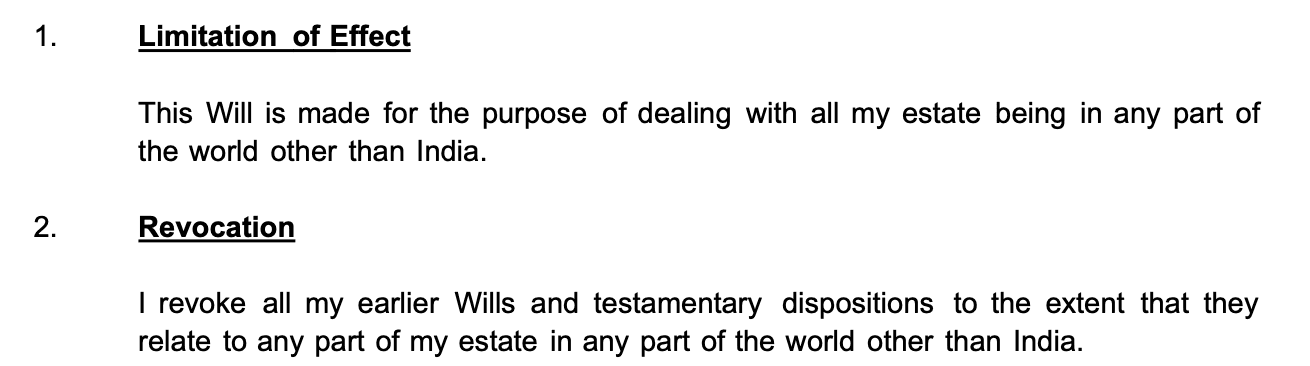
Our will writer advised us to keep wills for assets in different countries separate, as they have their own laws regarding wills. The will writer added the following statements to our wills to exclude our assets in India.
4. Timeline#
Below is our rough timeline. We moved slowly, but you could finish within a month.
- Day 0Day 0Filled in the referral form
Completed an online form via Cancer Research UK's free will scheme with Co-op Legal Services. We had to fill in details about ourselves, children, assets, executors and backup executors, guardians for children, any gifts, beneficiaries and backup beneficiaries of our estate.
- Week 2Week 2Introductory call with administrator
Had a short phone call from Co-op Legal to discuss our circumstances and book the telephone appointment with a will writer.
- Month 1Month 1Telephone appointment with will writer
An hour-long call with the will writer. They were excellent and patient with our questions. We went through all of the details regarding the will.
- Month 1Month 1First drafts received
Received the draft wills and a commentary via email. The commentary explained each clause in plain English, which helped understand the legal language.
- Month 1–2Month 1–2Iterating on drafts
Several rounds of email back and forth to clarify questions we had and refine details. I also found it helpful to use AI to check the will, and asked the will writer to make changes accordingly.
- Month 2Month 2Final documents received
Received the final will documents ready for signing.
- Month 2–5Month 2–5Waiting to sign
Long wait as we needed two witnesses to be available at the same time to sign the wills. Co-op agreed to give us some more time to return the signed wills.
- Month 5Month 5Wills signed
Finally got friends together and signed the will. Posted it back to Co-op for storage, where it would be more secure than at our home. There was no additional fee for the storage service.
- Month 5Month 5Confirmation email
Co-op confirmed via email that they'd received and checked the signed will and that it was now stored safely.
- Month 5Month 5Photocopy received
Received a photocopy of the signed will, which we stored along with our other important documents.
5. Review your will every 5 years or after major life events#
The government recommends reviewing your will every 5 years and after major life events [gov.uk - Updating your will]. For any major changes, a new will is recommended. You may have to pay for updates if you use a professional will writing service.
6. A companion guide for your executor allows more detail and is easier to keep up to date#
An informal companion guide provides more detail and flexibility than a will, and is easier to keep up to date. Executing a will is a long, arduous process, and a guide is immensely helpful to the executor. Our will writer encouraged us to prepare a companion guide too.
I created the companion guide in Google Docs so executors could access it easily.
6.1. Key areas to cover#
The companion guide was about 10 pages long and took me a week to prepare. Here are the key sections.
- Aim of this doc — Defines the document as an informal guide meant for our executors.
- Personal notes — Personal notes to the executor or anyone else.
- Executors of the will — Contact details for the executors.
- Personal details — Dates of birth, previous addresses, emails, tax numbers, etc. that the executors will need to carry out your affairs.
- Important documents location — The physical location of original documents such as passports, certificates and corresponding digital copies in my iCloud.
- Steps — A list to guide the executor through steps to take both immediately after the death and throughout the following year. I also highlighted any important deadlines.
- Notify people. Lists specific family members, friends, and employers to contact.
- Care for children. Ensure children are cared for until they can be passed to legal guardians.
- Track expenses. Log all personal expenses incurred during the process so they can be reimbursed from the estate.
- Locate the will.
- Read up. The executor should thoroughly review the companion guide, the official wills, and other external resources regarding the probate process.
- Register the death with the UK government.
- Arrange the funeral as per our personal wishes.
- Hire a probate lawyer. As the executor is legally liable for any mistakes, professional help is essential.
- Tell Us Once service. Allows you to report the death to multiple government departments at once.
- Pay inheritance tax (if any).
- Apply for probate, i.e., the legal right to administer the estate.
- Inform other institutions. Notify utilities, banks, insurers, and digital platforms to stop ongoing charges.
- Share assets. Distribute the estate according to the will.
- Transfer digital assets. Identifies key digital subscriptions, domains, and cloud storage accounts that must be maintained and passed on to children.
- Other non-urgent tasks.
- Instructions for a surviving partner — Tax-planning steps if one spouse survives the other, e.g., ISA transfer [gov.uk - Inheriting an ISA from your spouse or civil partner].
- Appendix - Financial assets — Provides a comprehensive reference table of all bank accounts, investments, pensions, debts, and insurance policies.
- Appendix - Guardianship wishes — Our wishes for how our children should be raised, how their inheritance should be invested, etc.
6.2. Update the companion guide regularly#
I have set up a reminder to review the companion guide yearly. I also update the guide whenever our finances change significantly, e.g., when we get a new credit card.
7. Consider creating a Lasting Power of Attorney [LPA] alongside your will#
Alongside a will, consider creating a Lasting Power of Attorney to appoint one or more people, attorneys, to help you make decisions if you lose mental capacity [gov.uk - Make, register or end a lasting power of attorney].
MoneySavingExpert - Power of Attorney provides more guidance on the LPA.
Without an LPA, if you lose mental capacity, your loved ones must apply through court to become a 'deputy'. This is a long and expensive process [gov.uk - Deputies: make decisions for someone who lacks capacity].
There are 2 types of LPA:
- Health and welfare
- Property and financial affairs
They cost £92 each, or £368 for a couple (4 LPAs). Setting it up via gov.uk is straightforward. Because of the cost, I have not set these up yet, even though I know I probably should! 🙈
8. Conclusion#
Writing a will felt daunting before I started, but it turned out to be a simple process. The companion guide took more effort, but this should make our executors' job easier. If you have been putting this off, I'd encourage you to book an appointment with a will writer. That in itself should provide sufficient momentum to finish it off.
Please share your questions or your own will-writing/executing experience with me in the comments below.